
When Trees Start Growing In Your Gutters
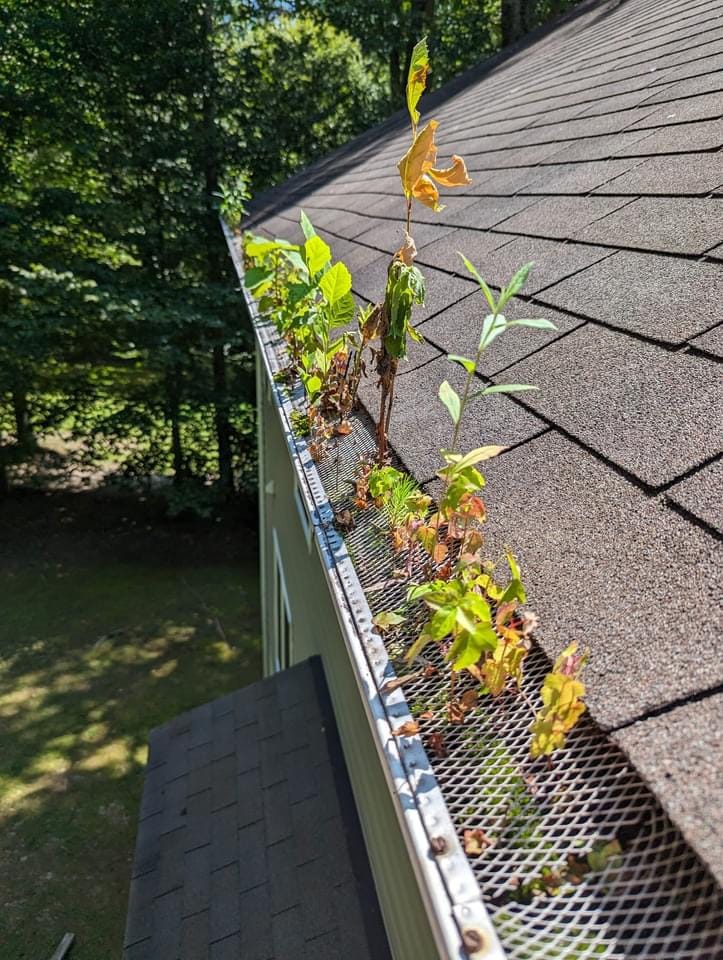
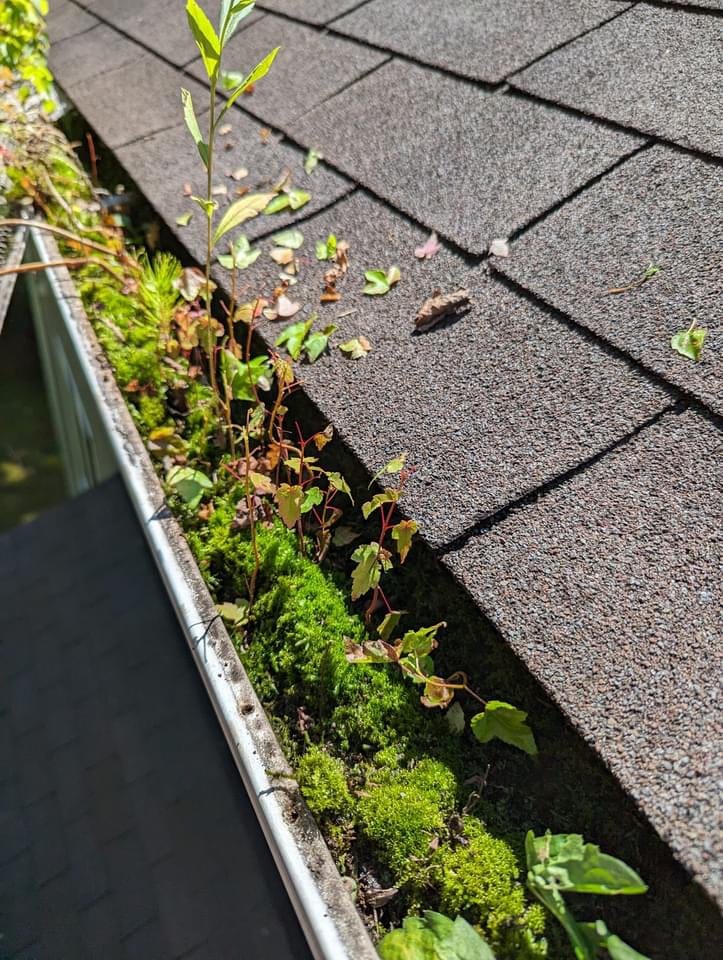
We took these photos on a gutter cleaning job outside Bastrop. They're not staged, and honestly they're not even that unusual. When a gutter goes a few years without service in Central Texas, this is the end state.
What's actually happening here
A gutter fills with leaves, pine needles and shingle grit. Rain packs it down. The bottom layer stays wet, breaks down, and turns into compost. Give it one more season and it isn't debris anymore — it's soil. And soil that sits in a warm, wet, sunlit trough is a genuinely excellent place for a seed to land.
Once moss establishes, it makes the problem worse fast. Moss holds water like a sponge, which keeps the trough permanently damp, which accelerates the breakdown of everything else in there and speeds up corrosion on the gutter itself.
Why this costs real money
A clogged gutter doesn't just stop draining. It redirects water to places your house was never designed to send it:
- Water overflows behind the gutter and runs down the fascia board, which is usually wood. Wet wood rots, and rotted fascia means the gutter loses what it's fastened to.
- Overflow sheets down the exterior wall, staining siding and brick and driving moisture behind them.
- Water dumps straight down at the foundation instead of being carried away — in Central Texas clay soil, concentrated water at the foundation is exactly the thing you're trying to avoid.
- A packed gutter full of wet compost is heavy. That weight pulls fasteners out of the fascia and sags the gutter line permanently.
- Standing water breeds mosquitoes all summer.
Rotted fascia and foundation drainage work cost many multiples of what routine gutter cleaning costs. This is one of the clearest cases in home maintenance where the cheap preventive thing genuinely prevents the expensive thing.
How often gutters actually need cleaning in Central Texas
The generic advice you'll find online says twice a year. That's a reasonable baseline here, but our tree canopy changes the math:
- Live oaks shed year-round rather than in one autumn dump, so there's no single 'after the leaves fall' moment that gets you clear until spring.
- Loblolly pines around Bastrop and the Lost Pines drop needles constantly, and pine needles mat together into a mesh that traps everything else.
- Pecans drop leaves, husks and limbs, and the husks in particular break down into exactly the soil layer that lets seedlings take root.
Practically: if your roof has significant oak, pine or pecan canopy over it, plan on three visits a year. If your roof is mostly open to the sky, twice a year is genuinely fine.
What about gutter guards?
Guards help. They do not make the problem go away. Look closely at the first photo — that gutter has mesh guards installed, and there are trees growing through them. Fine debris, shingle grit and pollen still work through, then compost underneath where you can't see it. And moss will happily grow directly on top of the mesh.
Guards mean less frequent cleaning, not no cleaning. Once a year is usually enough on a guarded system, but zero is not a real number.
How we handle it
We hand-clear the troughs rather than blowing everything onto your roof and lawn, flush every downspout to confirm water actually moves through, bag the debris and take it with us, and send you photos of anything we find along the way — loose fasteners, separated seams, rot starting on the fascia, or low spots holding water.
That last part matters more than the cleaning itself sometimes. We're on a ladder looking directly at a part of your house you never see. If something is starting to go wrong up there, you want to know while it's still cheap.
Need this handled?
We’re based in Bastrop and serve Central Texas. Free quotes, usually same day.